For years, design has been centred on the user.Understanding their needs, optimising their experience, and improving their interaction with products and services has been — and still is — essential.
But in an increasingly complex world, this approach is no longer enough.
Design decisions do not only affect the people who use a service, but also:
The organisations that sustain it
The systems in which it operates
The social and environmental context in which it exists
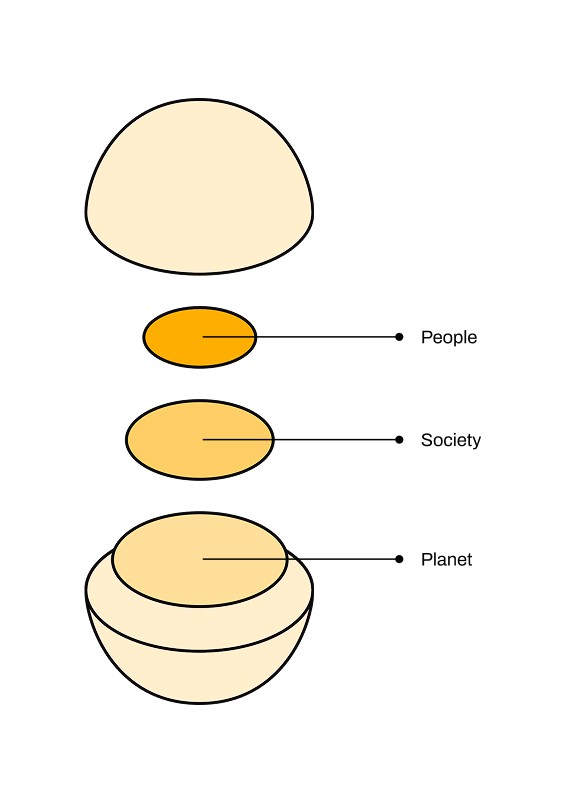
Life-Centered Design emerges as a necessary evolution: a way of designing that broadens the focus and considers the impact of solutions on the system as a whole.
What is Life-Centered Design?
Life-Centered Design (LCD) is a design approach that places life at the centre of decisions, not just the user.
This means understanding that any product, service, or experience is part of a broader system in which multiple actors, interests, and consequences interact.
Designing from this perspective means:
Going beyond optimising the experience of use
Considering the impact of decisions on the system
Understanding the relationships between people, organisations, and context
It is not about replacing Human-Centered Design, but expanding it.
From Human-Centered Design to Life-Centered Design
Human-Centered Design has been key to putting people at the centre. However, in many cases, it has led to optimising solutions without questioning their wider impact.
For example:
Improving the conversion of a service without considering its impact on operations
Designing efficient experiences that generate negative effects for other actors
Prioritising ease of use without taking long-term consequences into account
Life-Centered Design introduces a broader perspective:
It does not only ask, “is this useful for the user?”
But also, “what impact does this have on the system?”
Why it matters today
The current context requires new ways of designing.
Organisations operate in environments where:
01
Systems are complex and interconnected
02
Decisions have effects at multiple levels
03
Sustainability (social, economic, and environmental) is key
04
Trust is built over time
In this scenario, designing only from the user experience perspective can lead to incomplete or even problematic solutions.
Life-Centered Design makes it possible to address these challenges in a more responsible, strategic, and sustainable way.
What designing from a Life-Centered Design perspective involves
Applying this approach is not an extra layer, but a shift in perspective.
It means:
01
Broadening the focus
02
Understanding consequences
03
Connecting experience and system
04
Designing with responsibility
How we work through Life-Centered Design
At Ikigai, Life-Centered Design is not just a discourse, but a way of working.
We apply it by integrating:
Research to understand the full system
Strategic definition to make decisions with context
Solution design aligned with operational reality
This allows us to:
Avoid superficial solutions
Design with greater coherence
Generate real impact for organisations and people
If you are interested in exploring how to apply this approach in your organisation or your projects, we would be delighted to share our experience.
What makes it different from other approaches
Life-Centered Design introduces a layer that is often missing in design projects:
It connects strategy and execution
It integrates experience and operations
It incorporates impact and sustainability
It enables better-informed decisions
It is not only about designing better, but about designing with greater awareness of the system.